Building a Support Ticket Classifier from Scratch
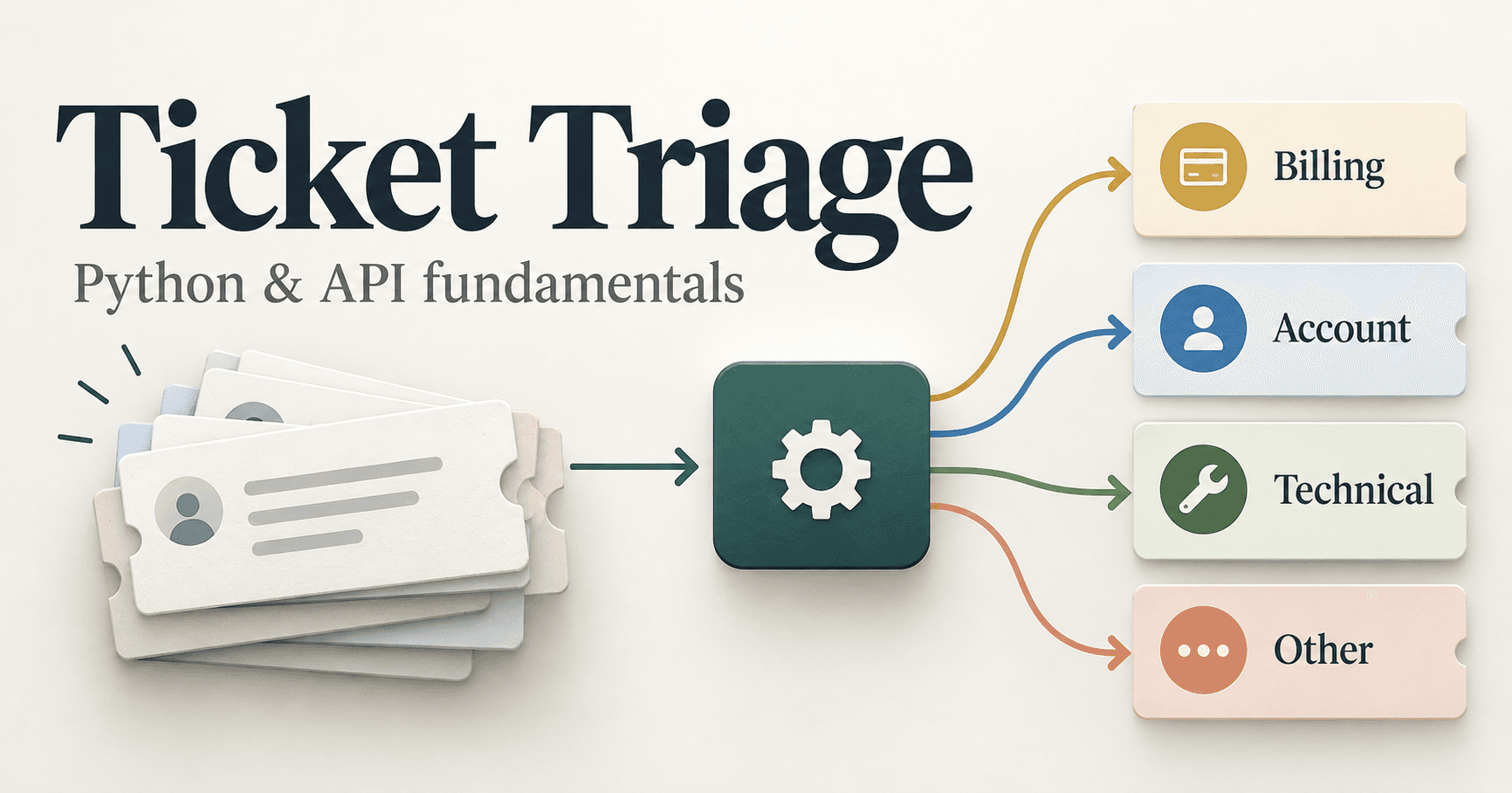
How I built a production support ticket classifier using Python, rule-based routing, OpenAI API integration, and evaluation metrics. A deep dive into the boundary between custom code and external APIs.
The Problem
Support teams face a daily challenge: tickets arrive without proper categorization. A billing question gets routed to technical support. A technical issue lands in sales. This manual work is slow and error-prone.
Most teams try one of two extremes: either they manually triage every ticket (expensive and inconsistent), or they implement a rigid rule-based system (fast but brittle). Neither scales well as the ticket volume grows.
The real problem isn't that automatic classification is hard. It's that most implementations conflate multiple concerns. They mix file I/O, parsing, schema validation, classification logic, API calls, and evaluation into one monolithic script. When something breaks, you don't know if it's your rules, your API call, or your parsing.
What I Built
A support ticket classifier that separates concerns cleanly. Here's how it works:
- Reads from JSON and validates structure with Pydantic
- Routes through a rule baseline using keyword matching and ranked precedence
- Calls OpenAI API for cases where simple rules don't work
- Measures accuracy against labeled examples so you know if it actually works
The classifier handles the boundary between my Python code and external APIs cleanly. I own the schema, the rules, the decision logic. The API handles the heavy lifting for edge cases. And the evaluation gates tell me when the hybrid approach is paying off.
The Architecture
The system flows through six clear stages:
- Load and validate: Read JSON ticket, parse with Pydantic, catch schema errors early
- Rule baseline: Extract keywords, apply ranked matching, get first classification
- API fallback: If confidence is low, ask OpenAI with a structured prompt
- Log results: Record both predictions with timing and token usage
- Compare with labels: Measure accuracy against human-labeled truth
- Analyze errors: Understand where rules fail and where API adds value
Each stage is independent. You can test the rule baseline without ever calling the API. You can evaluate API performance on a dev set before running it on production data. The separation of concerns makes the system easier to debug and improve.
Key Lessons
Building this classifier teaches four things that transfer to any AI application:
1. Schema-driven development
Pydantic models enforce structure at boundaries. Define what a valid ticket looks like before you write classification logic. Catch errors early.
2. Rules beat magic
A simple rule-based classifier catches 70% of cases instantly, with zero API cost. Add the expensive model call only for edge cases. This is how production systems actually work.
3. Evaluation gates control quality
Labeled examples and accuracy metrics are not optional. They're your safety gates. You can't improve what you don't measure.
4. The API boundary matters
Know where your code ends and the LLM begins. You control validation, determinism, cost. The LLM handles ambiguity and edge cases. Clarity on this boundary makes the system predictable.
See It In Action
I built a full walkthrough showing the classifier handling real ticket scenarios. The video covers project setup, the rule baseline, API integration, and how to measure what actually works:
The full source code is on GitHub. It includes starter templates, test cases, and a reference implementation:
Why This Project Matters
This classifier is more than a toy example. It teaches the real patterns you'll use in production:
- Hybrid systems (rules + AI) are how production apps actually classify data
- Schema validation catches errors before they hit your API
- Evaluation metrics turn guesses into facts
- Separating concerns makes debugging and improvement possible
If you can build this classifier, you can build any customer-facing AI system that needs to be reliable, fast, and cost-efficient.
Ready to build one yourself?
Start with the GitHub repository I built. Follow the lessons step-by-step and have a working ticket classifier running on your machine.